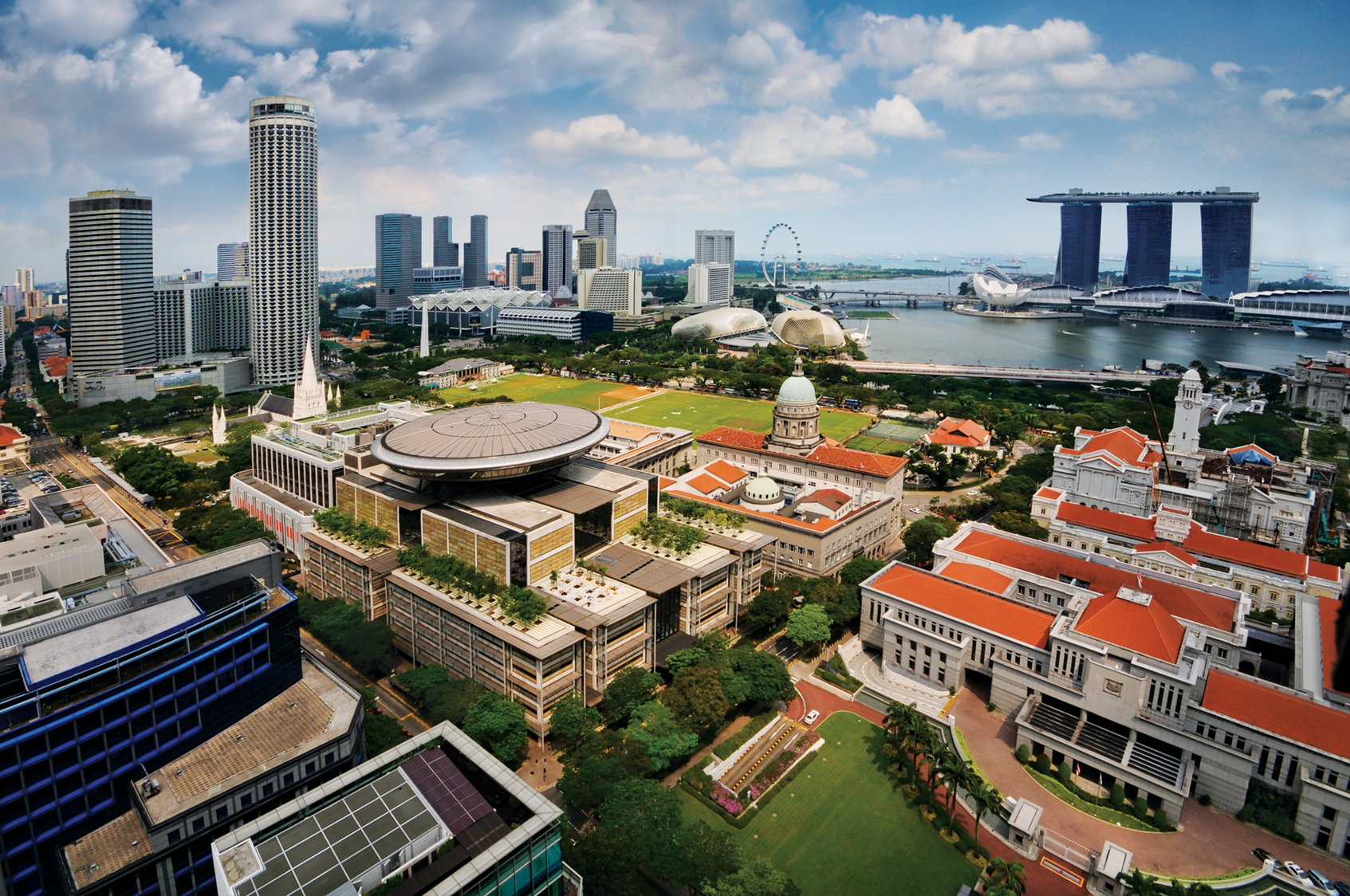
The stretch of land between St Andrew's Road and the north bank of the Singapore River concentrates more significant colonial public buildings per hectare than any comparable district in Southeast Asia. Within roughly 500 metres of each other stand a 19th-century courthouse that became a Parliament, a Palladian theatre that doubled as a memorial hall, a neoclassical post office repurposed as a hotel, and a Cenotaph designed by the same architect who built the Supreme Court.
These buildings were not planned as an ensemble. They accumulated over 120 years — from the earliest government bungalows of the 1820s through the last colonial public works projects of the 1930s — each reflecting the priorities and aesthetic conventions of its moment. That they read as a coherent district today is partly the result of shared stylistic references (British classicism in its various period inflections) and partly the result of conservation decisions that treated the area as a unity from the 1980s onward.
The Padang and its framing buildings
The Padang — the open field at the centre of the Civic District — was the spatial reference point around which colonial Singapore's public buildings were arranged. Raffles designated the area as a public ground in the original 1822 Town Plan, stipulating that it should remain open. The buildings that came to frame it were placed in deliberate relationship to this open space: set back behind wide gravel or grass margins, oriented to present their formal facades to the field.
The Singapore Cricket Club, which occupies the southern corner of the Padang, was rebuilt in its current form in 1884. The original pavilion structure was extended in 1906 and again in the 1920s. The building presents a long, colonnaded facade to the Padang — a practical arrangement that provided covered seating for spectators and also created a formal architectural screen between the field and the European residential streets behind.
The Singapore Recreation Club, at the northern end of the Padang, followed a similar logic. Together, the two clubs frame the field without enclosing it, anchoring the social geography of colonial Singapore's European community around a shared outdoor space.
City Hall and the Supreme Court
City Hall (completed 1929) and the former Supreme Court (completed 1939) form the most architecturally unified pair in the Civic District. Both were designed under the direction of Public Works Department architects working in a monumental neoclassical mode, with Corinthian columns at major facades, heavy entablatures, and Portland cement rendered to resemble stone.
City Hall's main facade on St Andrew's Road has a full Corinthian colonnade — twelve columns across, supporting a deep entablature — that reads as a deliberate statement of governmental permanence. The building housed the Municipal Offices and later the General Post Office before becoming City Hall. Its steps were the site of Lord Louis Mountbatten's formal acceptance of the Japanese surrender in September 1945 — a fact that has given the building a significance in Singaporean national history that transcends its architectural merits.
The Supreme Court, designed in a slightly later and more confident neoclassical manner, replaced an earlier Hotel de l'Europe on the same site. Its green copper dome — still visible from the river and from elevated positions across the city — was the only dome in colonial Singapore's public architecture and was clearly intended to signal the authority of the British legal system with a visual language borrowed from the dome of St Paul's Cathedral and the Old Bailey in London.
The dome was not a structural necessity — the building could have been roofed without it. It was a skyline claim: the law, visible from the river, from the merchant quarter, from the residential hills.
Both City Hall and the former Supreme Court have been adapted into the National Gallery Singapore, which opened in 2015. The conversion, designed by the architectural firm Studio Milou Singapore, retained the exterior fabric of both buildings almost entirely while connecting them internally through a glass and steel roof structure spanning the former service yard between them. This is one of the most ambitious adaptive reuse projects in Singapore's conservation history.
Victoria Theatre and Concert Hall
The Victoria Theatre (1862) and the adjacent Victoria Concert Hall (originally the Town Hall, 1905) are the oldest surviving public entertainment venues in Singapore. The theatre was built to replace an earlier assembly rooms building on the same site; the Town Hall was added four decades later as a memorial to Queen Victoria.
The clock tower that links the two buildings was added in 1906 as part of the Town Hall construction. It has become the most recognisable element of the complex and one of the most photographed structures in the Civic District. The tower's proportions were calculated in relation to the dome of the Supreme Court across the Padang: its height was set to complement rather than compete with the larger building's silhouette.
The complex was restored between 2010 and 2014 in a project that addressed significant structural deterioration in the 1862 theatre building. Original cast-iron columns, plaster cornices, and timber floor structures were retained or repaired in place. The concert hall's main auditorium ceiling — a coffered plaster work of some complexity — was fully restored using traditional lime-plaster techniques.
The Old Parliament House
The building now known as the Arts House — used by the Singapore Parliament from 1954 to 1999 — is the oldest surviving government building in Singapore. The original structure, completed in 1827, was designed by George Drumgoole Coleman, the Irish architect responsible for much of Singapore's earliest monumental architecture. Coleman worked in a restrained neoclassical style suited to the building materials available in early colonial Singapore: local brick, lime plaster, and Burmese teak for structural elements.
The original 1827 building served as the residence of a wealthy merchant before being taken over for government use in 1841. It was extended and modified several times — notably in 1875, when a new chamber was added to accommodate the Legislative Council, and in 1953, when further extensions prepared it for use as a full Parliament chamber after self-government.
The building's bronze elephant — a gift from the King of Siam to the colonial government in 1872 — stands in front of the main facade. It remains in place and is one of the few pieces of outdoor sculpture in Singapore with a documented 19th-century provenance.
Empress Place and the Asian Civilisations Museum
The building that now houses the Asian Civilisations Museum was constructed between 1865 and 1867 as the Central Police Court and expanded several times through the 1920s. The final extension, completed in 1920, gave the building its current neo-Renaissance river facade — a two-storey colonnade with arched windows that faces the Singapore River from the north bank.
The building's position at the mouth of the Singapore River — where the river widens into Marina Bay — made it one of the most visible public buildings in colonial Singapore for maritime arrivals. The facade was designed with this approach in mind: the colonnade and the regular spacing of the arched windows create a formal screen that reads as monumental from the water.
The conversion to a museum, completed in 2003, opened up the interior considerably. The original courtroom spaces on the upper floor were adapted into gallery rooms, with original joinery retained where it was compatible with display requirements. The ground floor, previously occupied by holding cells and administrative offices, was converted into an entrance atrium.
Materials, construction, and labour
The public buildings of the Civic District were built predominantly from local brick and lime plaster, with structural timber sourced from Borneo and the Malay Peninsula. Portland cement was used from the 1900s onward for rendered facades and structural concrete elements. Granite for foundation stones and kerbing came from quarries in Pulau Ubin and the Bukit Timah area.
Labour was almost entirely provided by Chinese migrants working through kangchu (labour contractor) systems that dominated the construction industry in 19th and early 20th-century Singapore. The skilled craftsmen responsible for plasterwork, timber carving, and tile-laying were typically Hokkien or Teochew specialists who moved between colonial public works projects and private construction.
The irony noted by architectural historians is that the buildings most associated with British colonial authority were built largely by Chinese immigrant craftsmen using techniques and material traditions that owed nothing to Britain. The neoclassical pilasters and cornices that signal British permanence were executed by men whose own architectural heritage was entirely different.